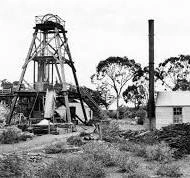
Things you may like to know about 50 Fraser St, Diamond Creek . The Land Development formally known as “Mine Hill”
<Best Viewed on a full screen not mobile device>
History
Gold mining in Diamond Creek began in the early 1860s (notably 1862) on the hills behind the township, specifically around "Mine Hill" and near the present-day Main Road and Dering Street. Major operations included the Union and Diamond Creek mines, which thrived for decades, producing substantial gold until a 1915 fire marked the industry's decline.
Key Historical Aspects of Gold Mining in Diamond Creek:
· Discovery and Early Mining: Gold was discovered in 1862 by Joseph and David Wilson on land bordering early settlers' properties. It quickly became a significant industry, with reefs running through the hills, prompting a shift from alluvial to quartz mining.
· Major Mining Sites:
· The Union Goldmine: Located on the south side of "Mine Hill," it was a major operation by 1870, featuring a shaft, steam-powered winder, and battery. It closed in 1875, reopened in 1904, and finally closed in 1908.
· Diamond Creek Gold Mine: Situated on top of Mine Hill, this mine was a staple for 30-40 years, continuing to produce well into the 20th century.
· Nillumbik Mine: Located on the western side of Scrubby Creek.
· The 1915 Fire: The main Diamond Creek Gold Mine was destroyed by fire in 1915, ruining the above-ground works and the main shaft,, which proved to be a fatal blow to the local industry, shifting the town's focus toward agriculture and fruit growing.
· Operations and Life: Mining was difficult, with early operations using rope cables prone to accidents before safer technology was introduced. The mines often employed around 200 men, deeply impacting the community.
· Post-Mining Activity: There were attempts to revive the industry, including reopening during the 1950s, but these were largely unsuccessful due to flooded shafts.
· Environmental Legacy: The area contains quartz reefs with associated minerals (gold, arsenic, zinc), and historical crushing left mullock heaps in the area.
Today, while no visible, large-scale structures remain, the history of "Mine Hill" remains a significant part of the Diamond Creek heritage.
Read about It
https://www.nillumbikhistory.org.au/diamond-creek-gold-mine-fire-1915-its-impact-on-the-community/
*** Disclaimer ***
This is just freely available information on the internet.
Please do your own research
Legacy of Arsenic in Gold Mines
Gold Mining Legacy
Historical gold mining has left a, toxic legacy of arsenic (As) contamination in soil and groundwater worldwide, particularly from abandoned mine tailings and roasting processes. Arsenic, often locked in arsenopyrite, was released into the environment, posing severe, long-term health risks including cancer and environmental degradation.
Key Aspects of the Legacy
· Environmental Persistence: Waste, tailings, and "grey sands" from historical operations (1800s-1900s) often remain on or near the surface, continuing to release arsenic into landscapes.
· Health Hazards: Arsenic is a carcinogen that can cause cancer, particularly when contaminated dust is inhaled or ingested, with children being at highest risk.
Mine Hill, AKA Diamond Creek Gold Mine, AKA 50 Fraser st Mine site was an abandoned mine hence Waste and Mine tailing were never removed.
Even after all the recent developments post 2000 no tailing were ever removed from site just churned into the existing soil.
As Early as 1998 the Council was well aware of the Mine Shaft and Arsenic issue that the 50 Fraser St site presented.
https://www.who.int/news-room/fact-sheets/detail/arsenic
Real life impact
Based on a 2018 report by A Current Affair on Facebook,50 Fraser St was identified as a site with arsenic contamination affecting surrounding residential properties. This contamination, highlighted in investigations into local environmental safety, caused significant concern for residents in the area.
· Location: 50 Fraser St (likely Australia, based on the legal firm involved in the report).
· Issue: Residential properties in the vicinity were affected by arsenic, prompting investigations.
· Report: Featured on A Current Affair in September 2018, according to this Facebook post.
For more specific information on remediation or the exact location, please refer to local council records or the legal firm mentioned in the report (Gordon Legal).
https://www.facebook.com/gordonlegalaus/videos/233292314020033/
A young family has been forced to move out of their home in Melbourne’s north-east after discovering their house was built on toxic land.
Now remaining residents are demanding answers as they claim authorities knew about the contamination for 20 years but have done nothing – in some cases, they even refused to test some homes and left many in limbo.
Labelled “Arsenic Avenue”, the abandoned gold mine site in Fraser Street, Diamond Creek contains higher concentrations of arsenic in its soil. Arsenic is a poisonous metallic compound which has been linked to cancer.
Mother-of-three Kim **** had lived close to the site for 16 years but only found out her property was riddled with arsenic after her insurance company was looking into a flood damage claim in December 2017.
According to environmental toxicologist Suzie Reichman, children are the most vulnerable to arsenic poisoning.
The normal range for children is under 100nmol/mmol but in a recent test, Ms **** two-year-old son had a reading of 474nmol/mmol, and her four-year-old a reading of 143nmol/mmol.
Kim had to sell her house well under market value and move to a safer area to raise her children.
Key Accumulation and Health Facts about living with Arsenic
· Targeted Tissues: While arsenic is mostly excreted through urine, it accumulates in hair, nails, skin, liver, kidneys, and muscles.
· Long-Term Effects: Chronic low-level exposure can take years to show symptoms, which typically begin with skin pigmentation changes, warts on hands/feet, and peripheral neuropathy (tingling in hands/feet).
· Cancer Risk: Inorganic arsenic is a recognized human carcinogen, increasing the risk of bladder, lung, liver, and skin cancers.
· Organ Damage: Long-term accumulation can result in liver and kidney damage, diabetes, and cardiovascular diseases.
· Accumulation in Children: Children may be more susceptible to arsenic exposure, as they are less efficient at converting inorganic arsenic into less toxic, excreteable forms.
EPA Studies as Early as 2000

What was known 20+ years ago
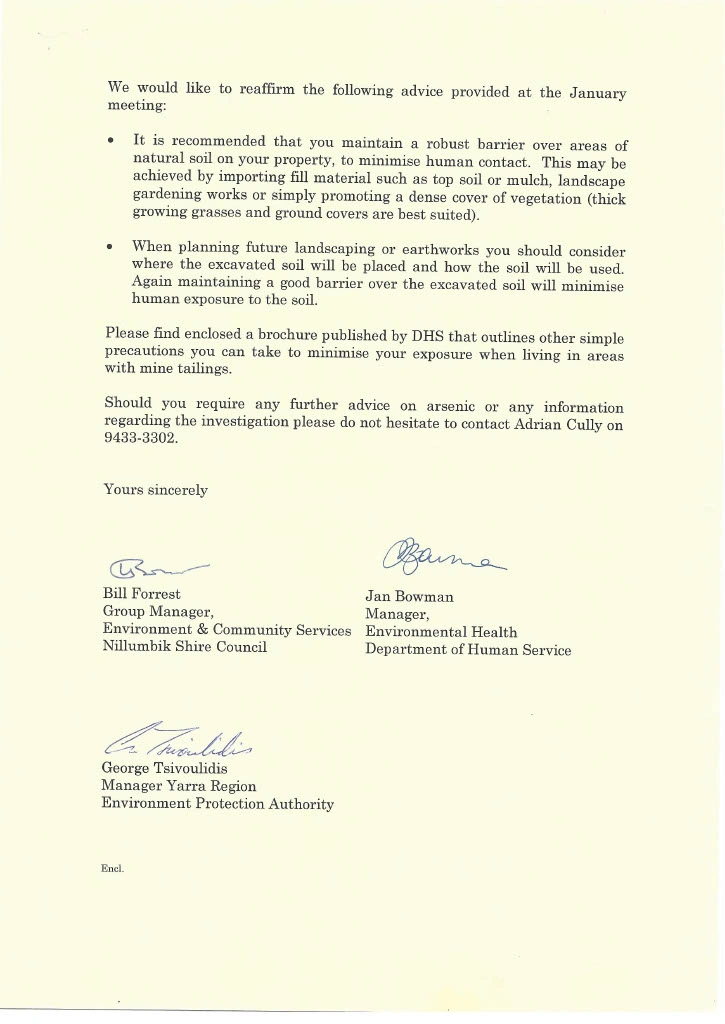
1: Letter from Council to local residents..
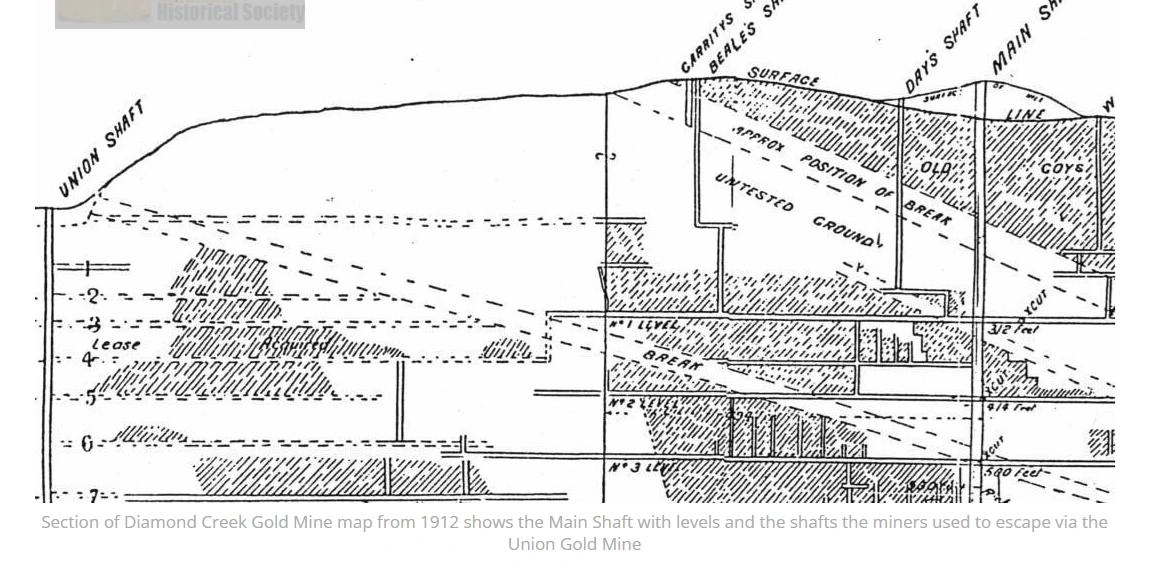
2: Archival image of mine shafts in the area..
The two key points to think about.
Problem #1 Mine Shafts
There were four known Mine shafts on the development labeled 50 Fraser street but as it turns out only one was filled and capped with concrete, the other three remain somewhere on the land undocumented where properties are being sold.
Several incidents involving old mine shaft collapses have occurred in the Diamond Creek and surrounding Nillumbik area, highlighting risks from historical gold mining. A notable 2013 incident involved a man trapped in a disused shaft, while a 2019 collapse caused a significant sinkhole on One Tree Hill Rd, Smiths Gully.
· 2019 One Tree Hill Road Collapse: A disused 30ft, 50-year-old mine shaft collapsed near Smiths Gully, creating a large sinkhole.
· 2013 Rescue: A man was rescued after being trapped for four and a half hours in a mine shaft in the Diamond Creek area.
· Historical Context: The area has numerous, often unmapped, abandoned mine shafts, particularly in the bushland, which can become unstable.
· Risk Mitigation: The Nillumbik Council and local authorities often have to repair and secure these sites due to the risk of, as described, the area being "like Swiss cheese".
The region's history of gold mining leaves many old shafts, posing ongoing risks for sinkholes in the Diamond Creek area.
https://www.youtube.com/watch?v=8JNIZwuB-fI
Problem #2 - Arsenic
Living in areas with high arsenic contamination, particularly through contaminated groundwater and soil, causes severe, long-term health issues and significant quality-of-life challenges. Arsenic is highly toxic in its inorganic form, and chronic exposure—even at low concentrations—is a major public health concern associated with cancers, skin diseases, cardiovascular issues, and developmental problems.
Key Health Issues Related to Chronic Exposure
· Skin Disorders (Arsenicosis): The most common early signs are skin changes, including hyperpigmentation (dark, patchy spots often described as "raindrops on a dusty road") and hyperkeratosis (hard patches or warts on the palms and soles of the feet).
· Cancer: Long-term ingestion of inorganic arsenic is a confirmed human carcinogen linked to increased risks of skin, lung, bladder, liver, kidney, and prostate cancer.
· Cardiovascular Disease: High arsenic exposure is linked to high blood pressure, coronary heart disease, and a severe peripheral vascular disease known as "blackfoot disease".
· Neurological and Cognitive Effects: Chronic exposure, especially in children, has been linked to lower IQ, cognitive impairments, memory loss, and neurological complications.
· Diabetes and Metabolic Issues: Studies have shown a strong association between high arsenic levels and an increased risk of developing Type 2 diabetes.
· Reproductive and Developmental Issues: Pregnant women exposed to arsenic are at higher risk of adverse outcomes, including low birth weight, fetal malformations, and fetal death.
Environmental and Lifestyle Challenges
· Invisible Threat: Arsenic is tasteless, odorless, and colorless, making it impossible to detect without testing.
· Unsafe Water Supply: Groundwater is the main source of exposure. Residents may rely on contaminated wells for drinking, cooking, and irrigation.
· Soil and Food Contamination: Crops irrigated with contaminated water (e.g., rice) can absorb arsenic.
· Residential Hazards: In some areas, soil contamination from past agricultural pesticides or industrial waste poses risks.
https://www.epa.vic.gov.au/contaminated-land-historical-mining-waste
<<< Click Left / Right for more information >>